
Foundations, Platform Bases, and Slats – What Actually Supports a Natural Mattress in Houston
The mattress arrived in perfect condition. Certified organic latex, hand-tufted wool, a fifteen-year warranty. It went onto the box spring that had been in the guest room for a decade – the right size, looked fine, no obvious reason to replace it.
Eight months later, there was a visible depression across the center. The warranty claim was denied. The reason: improper foundation.
This is not a rare story. It is almost certainly the most common and preventable mattress problem there is. The support underneath a natural mattress matters more than most buyers are ever told.
Quick Answer
Most natural mattresses – latex, organic hybrid, and hand-nested coil constructions – do not need a box spring. They need firm, non-flexing support with adequate airflow underneath. Using the wrong foundation often voids mattress warranties and accelerates irreversible material breakdown. In Houston’s climate, airflow beneath the mattress is essential, not optional.
For most modern mattresses, including latex and hybrid models, a box spring is not necessary. A rigid foundation, platform bed with closely spaced slats, or approved adjustable base provides the correct support.
Key Takeaways for Houston Sleepers
- Box springs were designed for traditional innerspring mattresses. Most natural mattresses require a firm, non-flexing foundation – using a box spring causes uneven wear, hammocking, and warranty denial.
- Box spring and foundation are not the same product. Most retailers use the terms interchangeably. For a natural mattress, this distinction determines whether your warranty survives the first year.
- Slat spacing is the most commonly overlooked variable. For latex and organic hybrid mattresses, gaps wider than 3 inches allow the core to bow between slats and create permanent deformation that will not recover.
- Center support is non-negotiable for queen and larger sizes. A center beam with legs reaching the floor prevents structural bowing under the combined weight of mattress and sleepers.
- Under-mattress airflow is essential in Houston’s climate. Enclosed surfaces trap humidity and degrade natural materials from below. Maintain at least 6 inches of clearance between the floor and the base
Why Foundation Choice Is More Consequential in Houston
At 70 to 90 percent relative humidity through spring and summer, ambient moisture accumulates at the interface between the mattress and its foundation whenever airflow is restricted. When that surface is enclosed or non-ventilated, humidity becomes trapped at the mattress underside – degrading organic wool and latex at that contact layer and creating conditions for mold. A slatted foundation with at least six inches of floor clearance allows air to circulate continuously beneath the mattress, managing both moisture and heat in a way no enclosed surface can.
5 Foundation Myths Worth Correcting
Myth 1: You need a box spring.
Reality: Box springs were engineered for traditional innerspring mattresses – the two systems worked as a pair, with each layer designed to flex. Modern natural mattresses require firm, flat, non-flexing support. A box spring’s give creates a double-dip under a latex core: heavy hips sink through both layers simultaneously, pulling the lumbar spine out of neutral alignment. Most natural mattress manufacturers explicitly exclude box spring use from their warranty coverage.
Myth 2: A box spring and a foundation are the same thing.
Reality: They are not. A box spring contains springs or a semi-flexible grid and is designed to flex under load. A foundation is rigid – no springs, no give. Most retailers use the terms interchangeably. For a natural mattress, this distinction determines whether your warranty survives the first year.
Myth 3: Any solid, flat surface will support a natural mattress.
Reality: Firm support is necessary but not sufficient. Solid, non-ventilated surfaces – dense MDF, plywood, fully upholstered platforms – block all airflow beneath the mattress. In Houston’s climate, that becomes trapped humidity. The correct surface is both firm and ventilated.
Myth 4: Any platform bed is compatible with a natural mattress.
Reality: Most furniture-store frames carry slat gaps of 4 to 5 inches, designed for conventional foam. A latex mattress on slats wider than 3 inches gradually bows into the openings – a process called phantom sagging because it develops slowly and is usually blamed on the mattress. By the time it is visible, the deformation is permanent.
Myth 5: If the mattress feels fine now, the base must be fine.
Reality: Foundation problems develop over months, not days. A base that flexes slightly at center or lacks center support may feel acceptable for a season. By the time hammocking is noticeable, the damage is structural – and the first thing a warranty review examines is the foundation.
Foundation Types at a Glance
| Foundation Type | Natural Mattress | Latex Safe | Airflow | Houston Performance |
|---|---|---|---|---|
| Box Spring | Traditional innerspring only | No – voids most warranties | Moderate | Not recommended — flex damages natural materials, voids most warranties |
| Rigid Foundation | All natural mattresses | Yes | Moderate | Good – choose vented sides, not enclosed box |
| Slatted Foundation (≤3″) | All natural mattresses | Yes | Excellent | Best choice – firm support + under-mattress airflow |
| Platform Frame (≤3″ slats) | All natural mattresses | Yes | Good | Good – measure slat spacing before placing mattress |
| Adjustable Base | Latex + hybrid (confirm per brand) | Confirm per brand | Good | Good – steel components preferred in humid climate |
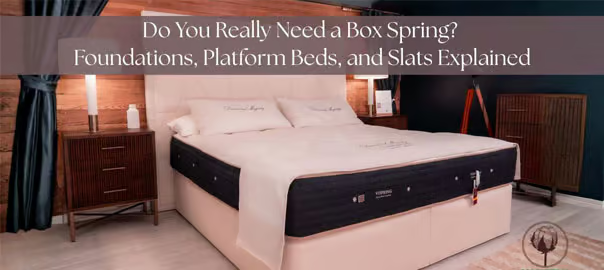
| Divan Base | Matched Vispring systems | Per manufacturer | Excellent | Good when matched – do not substitute cheaper base |
Green indicates the best-performing options for natural mattresses in Houston’s climate. Yellow indicates acceptable with conditions. Red indicates not recommended — for natural mattress constructions, a box spring is the single most common avoidable mistake.
What Each Natural Mattress Type Actually Needs
Natural latex is a dense, continuous material that relies heavily on the support surface beneath it. Slat gaps wider than 3 inches allow the core to bow permanently under repeated body weight. In Houston’s climate, slat material matters. Unfinished or unsealed wood absorbs ambient moisture over time and can warp; sealed or finished slats are the better choice for long-term stability. Latex also slides on smooth surfaces – non-slip corner grips from the first night.
Organic hybrids are more forgiving than all-latex constructions but still require a firm, non-flexing base with a center beam and floor legs for queen and above. Vispring and similar British hand-nested coil constructions are engineered as matched systems – the divan base is part of the engineering, not an accessory. Substituting a lower-cost alternative changes the support geometry the manufacturer calibrated.
The Structural Audit: Five Checks Before the Mattress Arrives
Most foundation problems are discovered after delivery – when the mattress is already on the frame and the warranty clock is running. These five checks take under ten minutes and give you exactly the information a well-informed buyer should walk into any showroom already knowing.
- Slat spacing: Measure gaps between slats. For latex and organic hybrid mattresses, 3 inches or less. If wider, order a slatted bunkie board before delivery.
- Slat flex: Press your knee firmly onto a center slat. Significant deflection under body weight is a warning sign – weak slats are the primary cause of phantom sagging.
- Center support: Queen, king, and California king frames must have a center beam with legs reaching the floor. Frames without center support will bow over time under the combined weight of the mattress and sleepers.
- Level check: Use a carpenter’s level or phone app across the center of the foundation. A half-inch bow in the frame becomes a visible depression in the mattress within months.
- Airflow and clearance: Confirm the surface is slatted, not solid, and enclosed. Maintain at least six inches of clearance between the floor and the base.
The Structural Audit: Five Checks Before the Mattress Arrives
- What foundation does this mattress warranty require? Read the warranty document, not a salesperson’s verbal assurance.
- If using an existing platform frame, measure slat gaps before delivery. Wider than 3 inches? Order a slatted bunkie board – not solid particle board, which blocks airflow.
- Does the frame have center support? For queen and larger, a center beam with floor legs is mandatory. Frames without center support bow over time regardless of surface quality.
- Is the foundation ventilated? An enclosed base without airflow is not the right choice in Houston’s climate regardless of surface firmness.
- Is the mattress part of a matched system? Use the specified base. For adjustable bases, confirm compatibility with the specific model, not just the brand.
Frequently Asked Questions
Do I need to buy a new foundation with my mattress?
Not necessarily. A platform frame with slat spacing of 3 inches or less, a firm non-flexing surface, center support, and ventilation may be fully compatible. A box spring should be replaced for any natural latex or hybrid mattress. Wide slat gaps are fixed most cost-effectively with a slatted bunkie board.
Can I put a natural mattress directly on the floor?
In Houston’s climate, placing a mattress directly on the floor is not recommended. Body heat radiating down through the mattress meets that cooler surface and causes condensation at the underside – the fastest path to mold beneath a significant investment. A raised, ventilated foundation with six inches of floor clearance is the correct setup.
What is a bunkie board and when do I need one?
A thin, firm, slatted panel with slat spacing of 3 inches or less – typically 1.5 to 2 inches tall – placed across an existing frame to create even, flat support. The practical fix when a frame is structurally sound but slat spacing exceeds 3 inches. Choose a slatted version, not solid particle board, to maintain airflow.
Will the wrong foundation void my warranty?
Yes, in most cases. Foundation incompatibility – including a box spring under a latex mattress – is one of the most common grounds for warranty denial. The warranty specifies what is required; it does not ask whether the mattress appears damaged.
Are box springs ever the right choice?
For traditional innerspring mattresses where the manufacturer specifies one, yes. For natural latex, organic hybrid, or some hand-nested coil constructions, no. The warranty documentation is the definitive answer.
Houston Natural Mattress
We carry natural and organic mattresses from Avocado, Naturepedic, The Natural Mattress Home, Vispring, and Posh + Lavish – each with specific foundation requirements, our team can walk you through before delivery day. Whether you are working with an existing frame or starting from scratch, we can help you identify the right support setup for your specific mattress and Houston’s climate. For bedding, we carry Coyuchi, Naturepedic, Avocado, and Sleep & Beyond.
We serve the Greater Houston Metro, including Rice Village, River Oaks, the Heights, Upper Kirby, Montrose, and the Museum District.
Your foundation is part of your mattress investment. Get it right before the first night.
Address: 6111 Kirby Dr, Houston, TX 77005
Phone: (832) 582-6324
Website: houstonnaturalmattress.com
Hours:
Monday–Friday: 10am–7pm
Saturday: 10am-5pm
Sunday: 12pm–6pm
About the Author
Amanda Demuth, MSN, RN · Wellness Advisor, Houston Natural Mattress · Member, American College of Lifestyle Medicine

Amanda is a wellness-focused writer passionate about sustainable living and sleep science. She specializes in natural mattresses and eco-conscious bedding, exploring how healthier materials and mindful choices can transform the way we rest. With a graduate degree in Nursing from Vanderbilt University and professional membership in the American College of Lifestyle Medicine, Amanda strives to promote the pillars of restorative sleep and the avoidance of toxic substances. She empowers readers to make informed decisions that benefit both personal well-being and the planet. Outside of her research on organic sleep solutions, Amanda enjoys forest hikes, sipping herbal tea, and embracing minimalist design.