
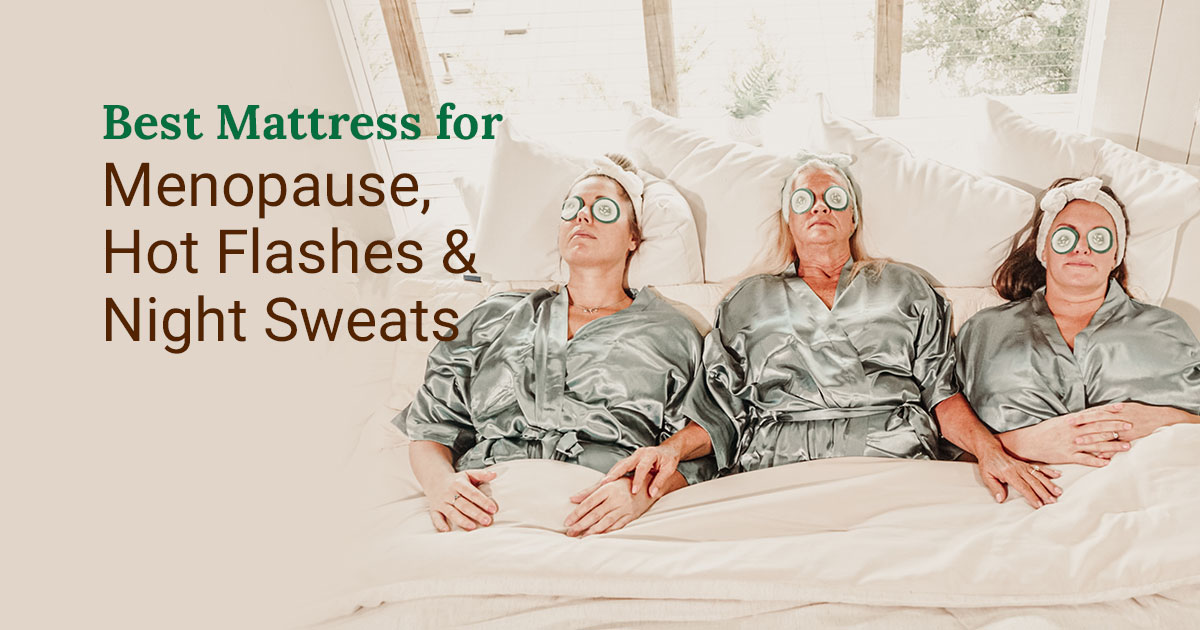
You are sleeping perfectly well, and then suddenly you are not. You are hot, the covers are on the floor, your pajamas are damp, and five minutes later you are cold. Now you are wide awake at 2:00 in the morning wondering whether the problem is you, the mattress, the bedding, or all three.
If this keeps happening, it makes sense to start looking for a “cooling mattress.” For many women, this is not a short-term problem. In the Study of Women’s Health Across the Nation, women who reported frequent hot flashes or night sweats had a median total symptom duration of 7.4 years.
For night sweats particularly, the problem is not only heat. It is what happens to the moisture afterward.
Quick Answer: What Is the Best Mattress for Menopause?
Start with a mattress that fits your sleep preferences, then look for a construction that feels responsive, breathable, and less enclosing. For hot sleepers, natural latex is a popular comfort material because it is buoyant, responsive, commonly perforated, and does not rely on the same slow, heat-responsive contouring as conventional memory foam. Paired with wool-rich upholstery and an open spring system, latex is one of the strongest combinations I would consider for hot sleepers dealing with night sweats.
The right firmness still depends on your weight, body shape, sleep position, and pressure points. Menopause does not create a new “correct” firmness.
Key Takeaways
- A mattress cannot stop a hot flash. It can make the bed more or less comfortable when one happens.
- Latex is a strong choice for hot sleepers because it is breathable, buoyant, and responsive, with less of the deep, slow sink associated with conventional memory foam.
- Wool is breathable and helps with moisture regulation, not just heat.
- The whole bed matters. A cool-touch cover cannot make up for a heat-retaining topper, less-breathable protector, or heavy bedding.
Why Hot Flashes Wake You Up
Hot flashes and night sweats are often called vasomotor symptoms. During menopause, changes in temperature regulation can make the body react more strongly to small temperature shifts, causing sudden heat, flushing, and sweating.
That helps explain why a night sweat can go from hot, to damp, to cold surprisingly fast. That is where the bed starts to matter.
What Should You Look for in the Mattress?
The first thing I would ignore is the word “cooling” on a mattress label.
I know that sounds strange, but “cooling” is often a marketing term that can mean anything from a cool-to-the-touch fabric to gel, phase-change materials, perforated foam, or a more breathable mattress construction. Some features can make the surface feel cooler at first without telling you much about how the entire bed will feel several hours later.
| Construction | Typical Feel | Why Hot Sleepers May Like It |
| All-latex | Buoyant and responsive | Pressure relief without a deep sinking sensation; perforated layers create pathways for airflow |
| Latex hybrid | Responsive with more spring | Latex on top plus open space through the spring unit creates additional pathways for airflow |
| Natural fibers over springs | Upholstered and traditional | Wool helps manage moisture while springs leave open interior space |
Why Natural Latex Is Such a Good Fit for Hot Sleepers
If sleeping hot is one of your biggest complaints, natural latex is one of the first mattress materials I would recommend.
Latex is commonly molded with small pinholes that create air pathways through the material. In a hybrid, the spring unit adds even more open space underneath.
Latex also springs back quickly and usually feels more buoyant and less deeply enveloping than slow-response memory foam.
That is the appeal: pressure relief, good ventilation, easy movement, and a less sunk-in feel.
For more detail, see Latex Mattresses in Houston, TX: The Complete Buyer’s Guide.
Why Wool Is Such a Good Fit for Night Sweats
Wool sounds like the last thing you would want when you are already hot. But wool is unusually good at doing two things: temperature regulation and moisture management.
Wool is hygroscopic, which simply means its fibers can take in moisture vapor and release it again as conditions change. It does not stop sweating or make a mattress cold, but it can help keep the sleep surface from feeling persistently damp and clammy.
That makes wool a natural partner for latex: latex gives you buoyant, easy-to-move-on comfort; wool helps manage moisture closer to the surface.
Amount matters. A thin wool quilt is different from a substantial wool comfort package.
For a deeper look, see Wool Mattresses in Houston: A Materials-First Guide to Cooler, Drier Sleep.
Why I Put Conventional Memory Foam Lower on the List
Memory foam can provide excellent pressure relief, but if your main complaint is waking hot and sweaty, it would not be my first choice.
Traditional memory foam often softens as it warms and contours closely around the body. That close cradle increases how much material is touching you and creates the “sleeping in the mattress” feeling many hot sleepers dislike. Slow-response foam can also make repositioning feel like more work.
Modern foam mattresses can add perforations, gels, phase-change materials, or springs. Those features can help, but for night sweats I would rather start with a naturally buoyant, responsive, and breathable material.
For more on cooling claims, see The Truth About “Cooling” Mattresses.
The Protector May Be Part of the Problem
You can buy a breathable mattress and completely negate its benefits with the wrong mattress protector on top.
If night sweats reach the mattress, protection is important. But waterproofing and breathability are not the same thing.
This is one reason we really like the Naturepedic Organic Waterproof Mattress Protector. It gives you real waterproof protection without wrapping the mattress in a thick, plasticky barrier. Naturepedic uses soft GOTS-certified organic cotton jersey with an ultra-thin waterproof layer designed to block liquids while still allowing water vapor to pass through.
For someone dealing with night sweats, that is exactly what you want: protect the mattress without creating another hot, clammy layer between you and the breathable materials underneath.
It is also soft, stretchy, quiet, and avoids the crinkly feel people often associate with waterproof mattress protectors.
Whatever protector you choose, ask what creates the waterproof barrier and whether it noticeably changes the feel or breathability of your mattress.
Houston Adds Another Wrinkle: Humidity
Houston does not cause hot flashes, but humidity can make the aftermath more uncomfortable.
Sweat cools your skin as it evaporates. Humid air slows that evaporation, so damp pajamas and bedding may stay uncomfortable longer.
For general indoor moisture control, the EPA recommends keeping indoor relative humidity below 60%, ideally between 30% and 50%.
That is home-moisture guidance, not menopause treatment.
Night-Sweat Bed Audit
| What You Notice | Possible Contributor | What to Check First |
| Bed stays warm after the episode | Heavy bedding or enclosing comfort layers | Top layers and mattress |
| Sheets or surface stay clammy | Protector, bedding, indoor humidity | Protector and sheets |
| You feel stuck when you move | Deep, slow-response layers | Mattress response |
| Shoulder or hip hurts once awake | Wrong firmness or too little cushioning | Mattress firmness |
| Your partner is comfortable and you are not | Shared covers, different preferences | Separate top layers |
| Bed became warmer after a recent change | New topper, protector, or bedding | Remove one change at a time |
Check the Rest of the Bed Before You Replace It
If your mattress is still structurally sound, start with the easier things first.
- Check the protector. If the bed changed after adding one, compare a more breathable option.
- Lighten the bedding. Two lighter layers are easier to adjust than one heavy comforter.
- Look at the sheets. Cotton percale and linen are good starting points.
- Check the room. Temperature, airflow, and humidity matter.
- Then look at the mattress. If it is sagging, uncomfortable, hard to move on, or too enclosing, compare other constructions.
A new mattress under the wrong protector and heavy bedding can still feel hot. The real issue may be a heat-retaining topper, a less-breathable waterproof protector, or tightly woven, heavily layered bedding.
Three Menopause Mattress Myths
Myth: A cooling mattress can stop hot flashes.
A better bed can make a hot flash easier to ride out and recover from, but a mattress does not treat or prevent hot flashes. Instead, look past the marketing claim and ask what the mattress is actually made from and how it is constructed.
Myth: If the cover feels cold, the mattress sleeps cool.
That first cool sensation can be pleasant, but it is only one part of the story. Some materials feel cool initially or absorb heat more slowly, but the construction underneath, mattress protector, and bedding all affect how the bed feels as the night goes on.
Myth: A softer mattress always sleeps hotter.
Not necessarily. Sinking more deeply can increase how much material touches your body, but materials and construction usually tell you more than the firmness label alone. Choose firmness for your body first, then compare constructions.
The 10-Minute Showroom Test
You cannot recreate a night sweat in a showroom, but you can test the parts that matter.
- Lie in the position you actually sleep in for at least 10 minutes.
- Bring your pillow, or use one with a similar loft.
- Check your pressure points first. Pay attention to your shoulders, hips, and lower back before thinking about “cooling.”
- Roll over. Does the mattress move with you, or do you feel stuck in a deep cradle?
- Compare different constructions at similar firmness levels.
- Ask what is actually inside. Find out what the comfort layers and support core are made from, where natural fibers are used, and what fire-barrier system the mattress uses.
Do not use ten showroom minutes to predict an entire night. Use them to decide whether your body actually likes the construction.
When the Mattress Is Not the Answer
If hot flashes or night sweats are regularly disrupting your sleep or quality of life, talk with your healthcare professional. Treatments are available to lessen symptoms.
It is also good to remember that not every night sweat is menopause. New, unexplained, severe, or persistent night sweats deserve medical evaluation.
Frequently Asked Questions
What mattress is best for menopause and night sweats?
For hot sleepers, I would start with natural latex, a latex hybrid, or a spring mattress with substantial wool or other natural-fiber upholstery. Firmness still needs to fit your body and sleep position.
Why is latex good for hot sleepers?
Latex is breathable, buoyant, responsive, and commonly perforated, which gives it a more open, less enclosing feel than slow-response memory foam.
A heat-retaining topper, less-breathable waterproof protector, or heavy bedding can still work against the more breathable mattress underneath.
Why is wool good for night sweats?
Wool can take in and release moisture vapor as conditions change, helping manage the damp, clammy feeling that can follow sweating.
Should I use a mattress protector if I have night sweats?
Usually, yes, especially if sweating may reach the mattress. Look for a waterproof protector that does not dramatically change the feel or breathability of the bed. The Naturepedic Organic Waterproof Mattress Protector is a great example of the kind of breathable waterproof protection we recommend.
Can menopause make my old mattress suddenly feel too warm?
Yes. Menopause can change how a previously comfortable sleep environment feels. Before replacing the mattress, check the topper, protector, sheets, blankets, room temperature, airflow, and humidity too.
Build a More Comfortable Bed in Houston
At Houston Natural Mattress, you can compare natural latex, latex hybrids, pocket-spring mattresses, and other natural-fiber constructions side by side.
Our salaried, non-commissioned team will explain what is inside each mattress in plain English and help you figure out what will work best for your specific needs.
Houston Natural Mattress
6111 Kirby Dr
Houston, TX 77005
(832) 582-6324
Hours:
Monday: 10 AM–7 PM
Tuesday: 10 AM–7 PM
Wednesday: 10 AM–7 PM
Thursday: 10 AM–7 PM
Friday: 10 AM–7 PM
Saturday: 10 AM–5 PM
Sunday: 12 PM–6 PM
Serving the Greater Houston Metro including the Heights, Rice Village, River Oaks, Upper Kirby, Montrose, and the Museum District and beyond.
Sources & Further Reading
- JAMA Internal Medicine: Duration of Menopausal Vasomotor Symptoms Over the Menopause Transition — Study of Women’s Health Across the Nation, 2015.
- Journal of Steroid Biochemistry and Molecular Biology: Menopausal Hot Flashes: Mechanisms, Endocrinology, Treatment — overview of hot-flash physiology and temperature regulation.
- Journal of Sleep Research: How Do Sleepwear and Bedding Fibre Types Affect Sleep Quality? A Systematic Review — review of bedding fibers, temperature, moisture, and sleep.
- The Menopause Society: 2023 Nonhormone Therapy Position Statement — evidence-based guidance on hot flashes and night sweats.
- U.S. Environmental Protection Agency: A Brief Guide to Mold, Moisture and Your Home — indoor humidity and moisture guidance.

Amanda is a wellness-focused writer passionate about sustainable living and sleep science. She specializes in natural mattresses and eco-conscious bedding, exploring how healthier materials and mindful choices can transform the way we rest. With a graduate degree in Nursing from Vanderbilt University and professional membership in the American College of Lifestyle Medicine, Amanda strives to promote the pillars of restorative sleep and the avoidance of toxic substances. She empowers readers to make informed decisions that benefit both personal well-being and the planet. Outside of her research on organic sleep solutions, Amanda enjoys forest hikes, sipping herbal tea, and embracing minimalist design.